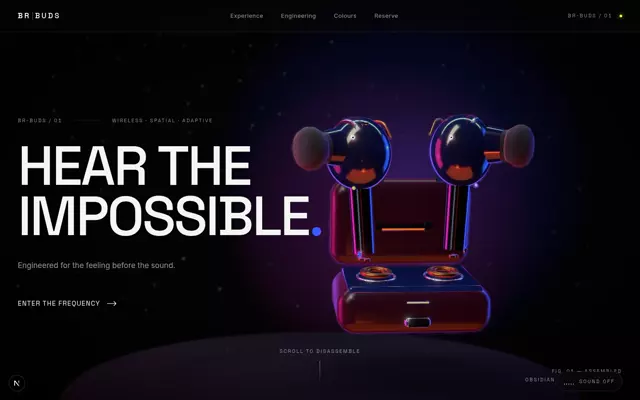
Ruturaj Jena — Augmented Portfolio
Two portraits share one hero: the pointer carves a liquid window between the designer and the engineer, and scroll turns the portrait into particles.
A personal portfolio built as one hover-reveal, scroll-driven WebGL film. The hero holds two pixel-aligned portraits of the same person in the same pose, one human and one augmented: moving the pointer carves a liquid window from one to the other, and a click floods the whole scene into the other world, changing the headline, the copy and the colour of the page with it. Scrolling dissolves the portrait into tens of thousands of particles that re-form as a different 3D shape for every section — a nebula, floating interface panels, an android, a data pipeline, a point-cloud bust and a globe — between a positioning statement, three pinned craft chapters, selected work, the stack, an about section and contact. One renderer runs three shader passes a frame; everything else is DOM animated with GSAP. Built with Vite and three.js, with no framework.
How to run this
Works the same on Windows, macOS and Linux. No prior setup beyond Node.js, and nothing to configure — the pack runs as-is.
- Built with
- Vite 8
- Requires
- Node.js 20 or newer
- Opens at
- http://localhost:5173
✦ Or let an AI agent set it up for you
Already using Claude Code, Antigravity, Cursor or Windsurf? Unzip the pack, open the folder as a project, and just ask:
Install the dependencies and run this project, then give me the URL
It reads the README included in the pack, runs the right commands for this project, and sorts out anything that trips along the way. You still need Node.js installed (step 1 below) — everything after that it can handle.
Or run it yourself
- 1
Install Node.js, if you don't have it
Download the LTS build from nodejs.org and run the installer — on Windows and Mac it handles everything. Mac users with Homebrew can run
brew install nodeinstead.To check it worked, run
node --version. It should print a number like v22.11.0. - 2
Unzip the pack, then open a terminal inside the folder
Windows: open the unzipped folder in File Explorer, click the address bar, type
powershelland press Enter.Mac: press Cmd+Space, type terminal, press Enter. Then type
cd(with a trailing space) and drag the unzipped folder onto the terminal window — it fills in the path for you. Press Enter. - 3
Install the dependencies
Run
npm installOne-time, and takes roughly 30–60 seconds. It creates a node_modules folder — that's expected, and it's why the zip doesn't ship one.
- 4
Start it
Run
npm run devThen open http://localhost:5173 in your browser. Leave the terminal open while you use it — closing it stops the site. Press Ctrl+C in the terminal to stop.
- 5
Optional — build for production
When you're ready to deploy,
npm run buildproduces the optimised output. The pack deploys to Vercel, Netlify or any Node host with no changes.
+ − If something goes wrong
- “npm is not recognised” / “command not found: npm”
- Node.js isn’t installed, or the terminal was open before you installed it. Close the terminal, open a new one, and try again.
- “Port 5173 is already in use”
- Something else is running there — often a previous copy of this site. Close the other terminal, or stop it with Ctrl+C.
- The page loads but images or video are missing
- Make sure you ran the command from inside the unzipped Ruturaj Jena — Augmented Portfolio folder itself, not the folder containing it.
- npm install shows warnings
- Warnings (as opposed to errors) are normal and safe to ignore. Only a message starting with ERR! needs attention.
Still stuck? Email us and we'll get it running with you.
More like this
Browse the store →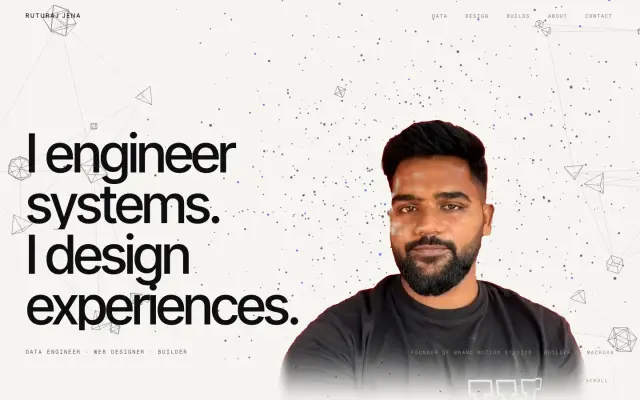 Premium
Ruturaj Jena — Creative Technologist Portfolio
One WebGL stage, three films scrubbed by scroll
 Premium
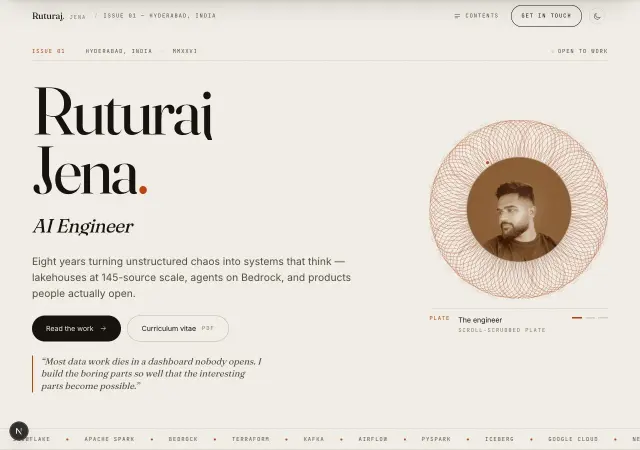
Ruturaj Jena — Editorial AI Engineer Portfolio
A personal site built like a printed magazine, not a résumé
 Premium
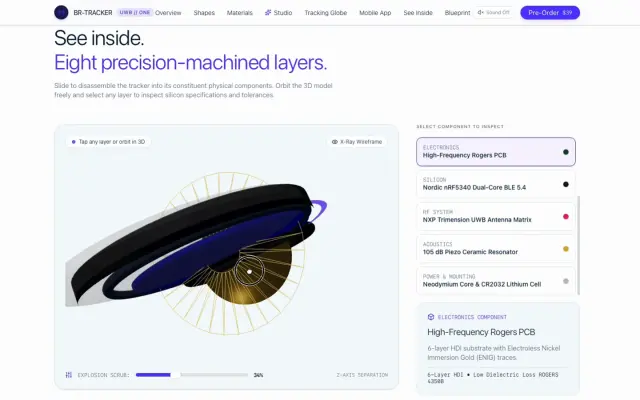
BR Tracker — Spatial Tracking Device
Eight form factors, one mesh. Every pixel of it is geometry.